Priority Four
Maintain Quality of Life Through Neighborhood Consensus Planning
This is the most important take-away: as Mayor, I will not sacrifice neighborhood quality of life, most especially when, as in the case of the recent Gibbons drive matter, there are approaches around which concerned neighborhood residents, City Hall staff, and local activists can reach a compromise. I was the only one to vote against the plan that kept the Gibbons left-turn closure alive. We need to keep Gibbons fully open and not move the traffic onto the narrower side streets.
Gibbons Drive Background
In the east end of Alameda in the Fernside neighborhood, on November 18, 2025, in a matter involving traffic calming improvements and street closure and realignment on Gibbon Drive, City Hall staff recommended to:
- first implement traffic calming improvements in 2027 on Gibbons; then
- study the effects of the improvement with respect to slowing-down traffic during the three-year 2028-2030 period, with the possibility that the study period that can stretch further to a fourth (2031) or fifth year (2032). Based on the prolonged study-period analysis, then
- determine whether to effectively close off northbound direct access to High Street Bridge via Gibbons by implementing a right-turn only realignment where Gibbon meets High Street and implement a set of crosswalk improvements (see “Green Area” in Figure 1 below).
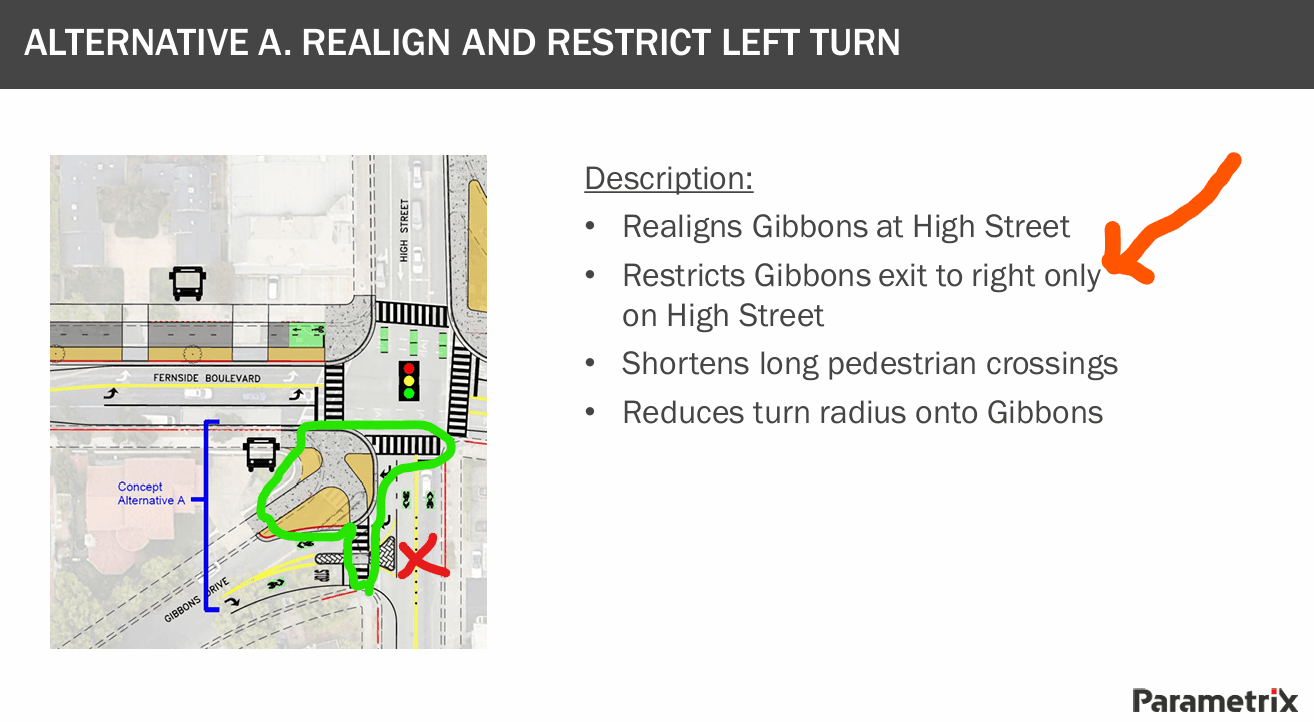
Why is City Hall staff proposing item “3” (i.e. “Alternative A” — effectively shuttering northbound direct access to the High Street Bridge via Gibbons) in the first place – and what are the collateral effects of this, if implemented?
The primary reason why City Hall staff proposed “Alternative A” to effectively preclude northbound traffic to the High Street Bridge via Gibbons is because, if the Figure 1 “Green Area” improvements were implemented in conjunction with allowing northbound Gibbon vehicular traffic to proceed to the High Street Bridge, then City Hall would need to install a new traffic light (see Figure 1 red “X”). The introduction of the new traffic light at “X” would, in turn, increase the time vehicles temporarily idle at the High \ Fernside \ Gibbons intersection, relative to a situation where there is no new traffic light as contemplated in “Alternative A”.
So, the answer to the question as to why City Hall staff proposed “Alternative A” (i.e. building Figure 1 “Green Area” improvements but not allowing direct northbound traffic to High Street Bridge via Gibbons) over “Alternative B” (i.e. building Figure 1 “Green Area” improvements but installing a new traffic light at “X”) is simply time and convenience.
Collateral Effects of Proposal to Ending Northbound Direct Traffic High Street Bridge Via Gibbons
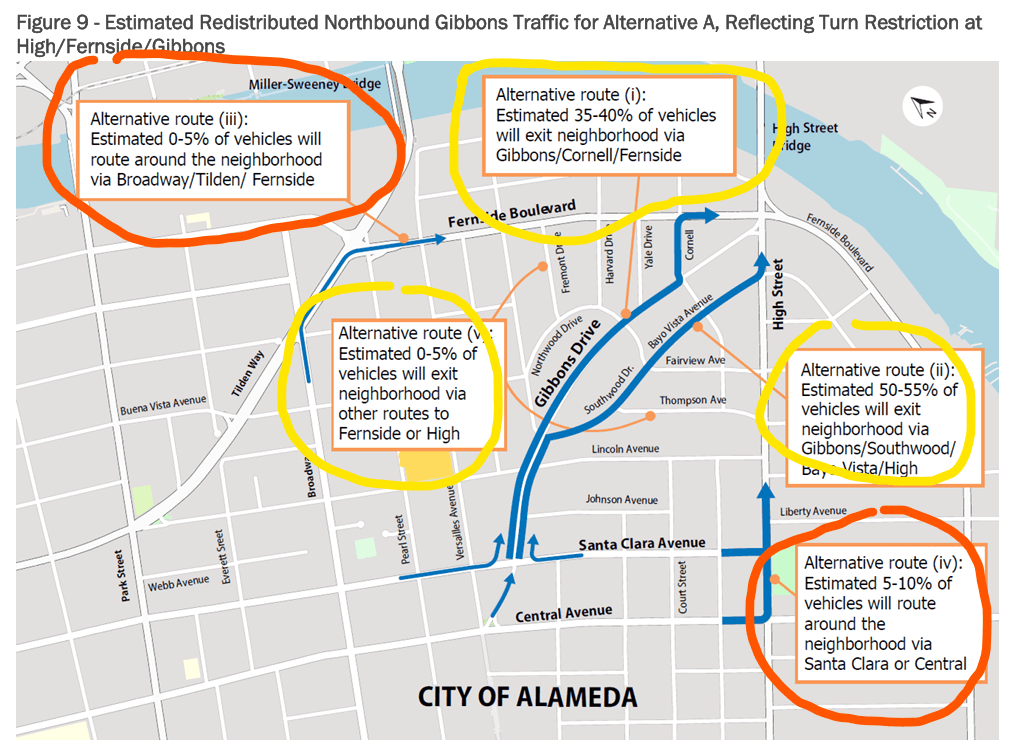
But . . . to me the most important question when I deliberated over the matter on November 18, 2025 was, “how will ‘Alternative A’ (i.e. precluding northbound direct access to the High Street Bridge via Gibbons) affect surrounding neighborhoods, for it stands to reason vehicles from other parts of Alameda travelling through Gibbons still need to get to High Street Bridge on their morning commutes?”
The figure below summed up the situation quite well: of the current peak hour volume of traffic flowing through Gibbons on a northbound trajectory toward the High Street Bridge, only 15 percent will take Broadway or Santa Clara Avenue (see “Dark Orange Circles”), while 85% will continue to cut through the Fernside neighborhood but find alternative paths via Cornell, Bayo Vista or other Fernside neighborhood streets (see “Light Orange Circles”). The figure below refers only to peak hour commute (7 AM to 9 AM) – traffic still will be occurring all day through the neighborhood streets.
Why I Oppose Both “Alternative A” and Intermediary Studies
The Alameda Post captured my position well as to why I voted no on the project, in reporting on the November 18, 2025 meeting:
“Councilmember Tony Daysog stated he would not support the staff recommendation because the data shows ‘extensive traffic spillage’ onto Cornell, Yale, and Bayo Vista if the left turn from Gibbons is removed. He noted that these streets are narrower, and diverted drivers ‘will drive faster’ to reach the High Street Bridge, creating a risk for residents east of High Street, particularly children crossing near Edison. He supported traffic calming on Gibbons, but strongly opposed restricting the left turn.”