Priority Three
Infrastructure and climate change
I will create a new “infrastructure and sea level rise commission” to oversee streets, sidewalks, sewerage infrastructure, and to oversee sea level rise strategies.
One of the greatest challenges we face is sea level rise (SLR) and climate change. This affects Alameda uniquely in that, along with Coronado in San Diego County, we are the only incorporated island out of 400+ incorporated cities in California.
Sea-level rise will damage not just the shoreline edge but also internal Alameda. East End residents with sump pumps know all too well the effects of Alameda’s high groundwater table – sea level rise will exacerbate their situation by sneaking more water underneath internal Alameda.
I say all this to also explain why I voted against placing the $300 million infrastructure bond on the ballot. Given the urgency of the SLR, the $300 million request needed to include a list of specific sea level rise and infrastructure (streets, sidewalks, and sewerage) projects that Alamedans know will be funded. There was and is no such list.
Why a list? Council has a duty to explain what specifically it is asking voters to fund (“what”?), where in Alameda construction of specific projects will occur (“where?”), and the cost of each listed project (“how much?”), so voters can then hold City Council accountable with respect to seeing approved projects come to life.
In promoting the $300 million bond measure, City Hall should have followed how the school district did things. The school district on January 25, 2022 specified “what, where, how much” projects (i.e. “Option 3” -- EHS’ new sports field, AHS’ swimming pool, Otis Elementary, etc.) that voters subsequently approved on June 7, 2022 in passing Measure B.
There is still time to implement strategies to deal with the great threat sea level rise poses – but residents need to understand which projects are to be funded and when they will be implemented before voting on a $300 million bond.
Finally, I will create a new “infrastructure and sea level rise commission” to oversee streets, sidewalks, sewerage infrastructure, and to oversee sea level rise strategies. The Commission will champion adequate budgeting of infrastructure every time the City Council adopts a city-wide budget to prevent deferred maintenances so out of control as to require a $300 million bond meant to “catch-up” on maintenance backlog. I advocated for such a commission which Council rejected – as Mayor I will create this commission.
What I will do as Mayor
Chase every state and federal dollar, relentlessly
Shoreline adaptation is exactly the category state and federal programs exist to fund, and Alameda has been an intermittent applicant. I will make grant pursuit a standing, staffed function with a public scoreboard: what we applied for, what we won, and what we left on the table.
Build natural shoreline first, hardscape only where it is unavoidable
Living shorelines, marsh, and De-Pave Park at Alameda Point are cheaper to build, cheaper to maintain, and they do more for habitat than a seawall does. Where hard infrastructure is genuinely the only answer, build it. But stop reaching for concrete first.
Publish a prioritized, costed list of shoreline, groundwater and infrastructure projects
You are entitled to a ranked list: which levee, which pump station, which stretch of seawall, what it costs, and what year it fails. Right now the $800 million is a slogan. A prioritized list turns it into a plan you can hold a Mayor to.
Defend what Alameda Municipal Power already gives us
A city-owned utility running a 100% clean portfolio at roughly 38% below PG&E is the largest climate asset this city owns, and it saves residents about $51.6 million a year. I will defend it, expand charging infrastructure across the island, and refuse to turn it into a revenue tap.
Concentrate growth at Alameda Point, not in flood-vulnerable neighborhoods
The former base is where Alameda can build at scale, on land we control, with transit designed in from the start. That is a climate position as much as a housing one. It is the difference between planning a neighborhood and retrofitting one.
How it gets paid for
Grants first, and pursued far harder than Alameda has ever pursued them. Then the existing capital budget, re-ranked. My view on this Council has been consistent: climate spending has to come from choices inside the current City Hall budget, and the burden is on City Hall to prove it has made those choices before it asks you for more.
On the $300 million bond, I have said above why I voted against putting it on the ballot. Let me be equally plain about the other half of it: the levees and the pump stations genuinely need the money. My objection is to the blank check. Give the voters the list and I will help make the case for it.
Why it matters
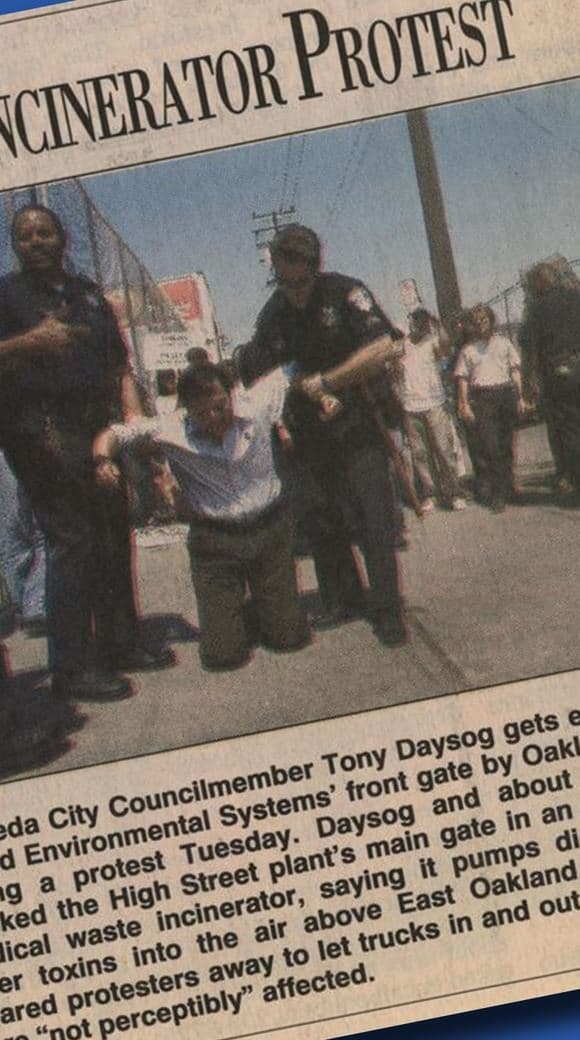
In 2001, as a sitting councilmember, two Oakland police officers carried me off by the arms at the gate of the High Street medical waste incinerator. I was blockading it over the toxins it pumped into the air above East Oakland and across this estuary. There is a photograph. It is on the record page.
I have never been a bystander on this, and I am not about to start now.
Sea level rise will not negotiate with Alameda's budget cycle. The homes first in line are on Bay Farm and the West End — the part of town I grew up in and never left. We either start the expensive, unglamorous work now, or somebody has to explain to our grandchildren why we didn't.